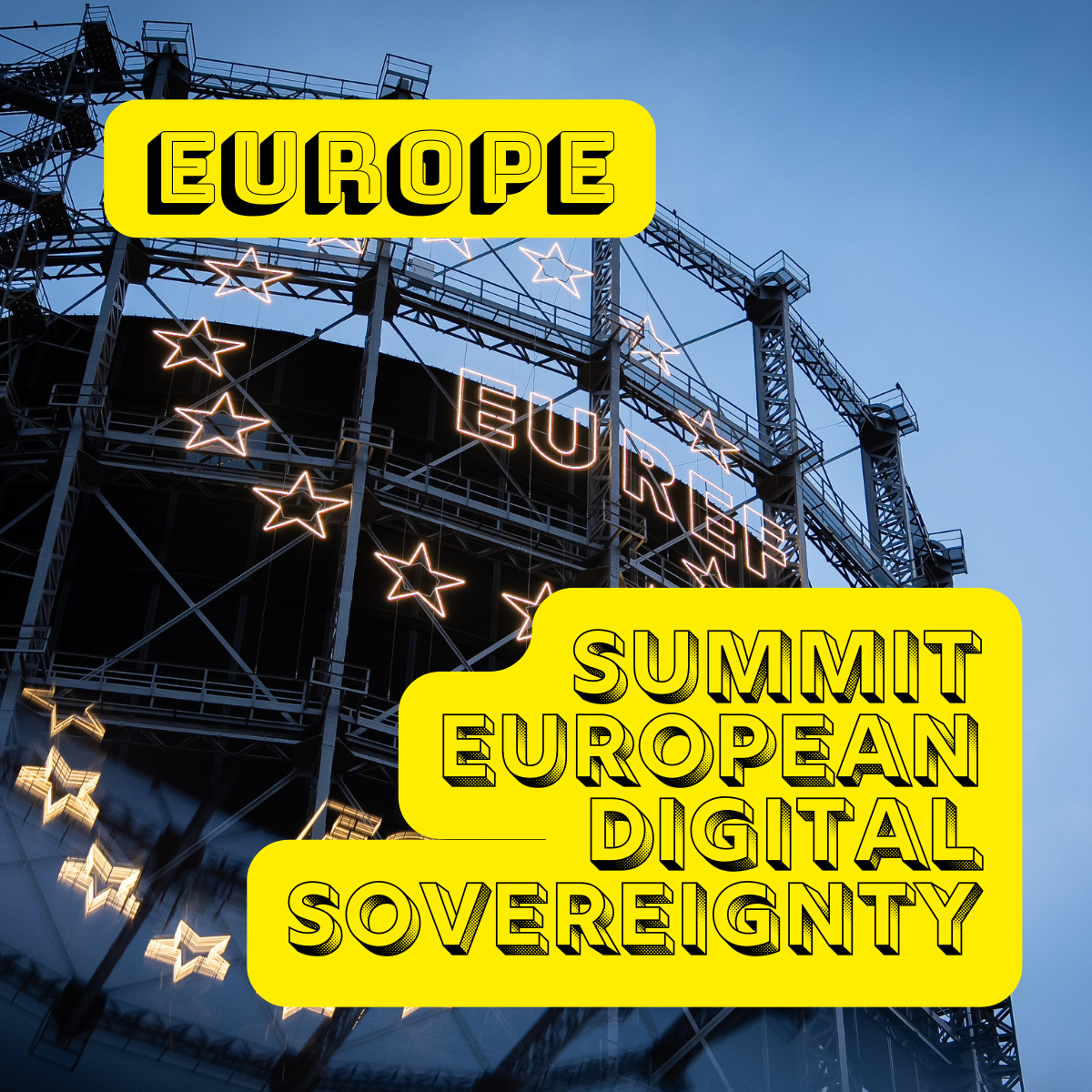
 Caption: Leaders gathering to discuss the future of European Tech Leadership.
The Paradox of European Potential
I had the privilege of attending the European Digital Sovereignty Summit 2025 today. The halls were filled with brilliant minds from the EU commission, research institutes, and businesses, all united by a common goal: strengthening Europe's technological future.
The message was consistent and clear: We have the talent. We have the ideas. We have the technology.
This leads to the essential question that lingered in the air: What are we missing?
The Investment Gap: Why Capital Flows Elsewhere
Investment doesn't appear by magic. It flows from people who believe an idea is hitting the market at the right time. This is true in China, the US, and here in the EU. So if we have the talent and ideas, why do China and the US attract multiples more tech investment than we do?
Recent reports highlight a staggering $375 billion capital gap between European and American growth companies. Furthermore, statistics from Digital Europe suggest that our share of global GDP has dropped significantly over the last three decades.
Are we doing something wrong? What makes those ecosystems so attractive to investors, and why isn't the EU competing at the same level?
It’s Not the Talent, It’s the Environment
The key difference, I believe, isn't the quality of our engineers or founders; it's the environment. Both the US and China have built powerful systems to empower small businesses and startups. They prioritize action and speed.
This isn't to say compliance and privacy should be ignored. However, recent initiatives like the EU Startup and Scaleup Strategy acknowledge that regulatory fragmentation is a major hurdle. If a startup's first major challenge is navigating a maze of pan-European legal frameworks before even validating their product, we are extinguishing innovation before it has a chance to ignite.
The Specialization Argument
I'm a tech founder with a passion for innovation. For me, the solution lies in specialization. This brings to mind a simple analogy regarding our current approach to governance and innovation:
"How can a fisherman solve a quantum equation? How can a quantum physicist know the best bait for a specific fish? Each is an expert in their own domain."
Are we sending the right people to solve our innovation challenges?
The summit speakers were excellent, but we need more venues where the actual founders, startups, and small business owners from across the EU can share their real-world issues. Top-down strategies, as noted in the Letta and Draghi reports, often miss the granular friction points that kill startups early.
Modernizing the Support Infrastructure
We need more government and institutional support, but there's a fundamental gap in how that support is delivered.
How can we receive cutting-edge support from public institutions that are, in some cases, still running on digital infrastructures as old as "Windows Vista"? To build a future-proof ecosystem, we must start from the ground up.
As Julius Caesar famously said: "Divide and conquer." Let's adapt this for 2025: Let the experts lead in their fields.
- Politicians should build frameworks for safety and fair play.
- Founders should drive product direction and market fit.
- Deep-Tech Experts should guide R&D policy, not generalists.
We cannot expect a mobility minister to solve a quantum computing challenge, just as we wouldn't ask a lawyer to be a fisherman.
Conclusion: Time for Action
A path for European tech innovation has been drafted. Initiatives like the Scaleup Europe Fund are promising steps, but policy papers do not write code or close sales.
It's time for less talk and more hands-on work. Europe must transition from a regulator of technology to a creator of it.